
Getting started
First launch
If you don't have the app yet, start with installation. After the first launch:
the interface is in Polish — to switch to English, choose Język → English from the menu (the menus are still in Polish at that point);
both panels show your home folder;
the window is 1200 × 800 points; the app remembers its size, position and panel paths when you close it.
The app window
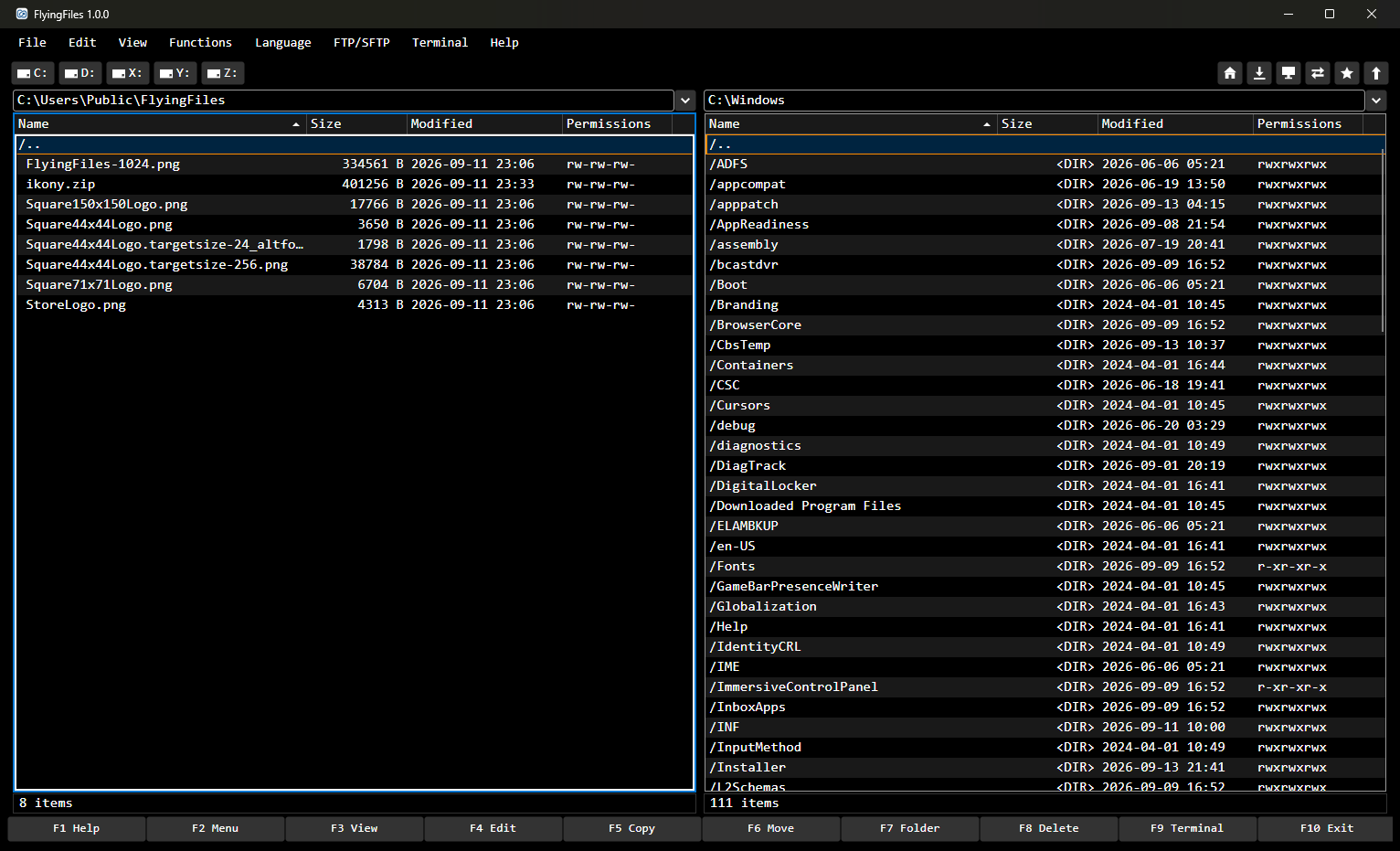
Menu — on macOS in the menu bar at the top of the screen, on Windows in the window: File, Edit, View, Functions, Language, FTP/SFTP, Terminal, Help.
Drive buttons on the left — on macOS the startup disk and connected volumes (USB drives, external disks, network shares), on Windows the drive letters. The tooltip shows the name, path and free space.
Place buttons on the right — icons only, with the names in tooltips: home folder, Downloads, Desktop, sync with the other panel, add the current path to favorites, and the root folder. They act on the active panel.
Path field of each panel. You can click it and type an address. The arrow button next to it opens a list of recently typed paths.
Column headers: Name, Size, Modified, Permissions. Click one to sort.
File list. The first row,
/.., leads to the parent folder. Folder names start with a slash (/Documents) and show<DIR>in the size column.Info bar — for the item under the cursor, its name, permissions, and owner and group; on the
/..row, the number of items in the folder.Disk space — a usage bar and the free space on the disk that holds the folder. New after 1.0.0.
F1–F10 key bar — reminds you what each key does; you can also click the buttons.
The window title shows the app name and version. Short messages also appear there for a few seconds, e.g. “FlyingFiles 1.0.0 — Copied 3 items”.
The active panel
At any moment you work in one panel — the active one. It has a distinct border in the accent color. The other panel is the destination: that's where copied and moved files go.
Tab switches the active panel.
Clicking a panel also makes it active.
The cursor is the row with orange lines above and below it. It marks the item the keys act on. Selected rows are bold and highlighted in color — selection is covered in chapter 3.
Your first copy
In the left panel, go to the folder with the file: the arrow keys move the cursor, Enter opens a folder, Backspace goes up a level.
Press Tab and, in the right panel, go to the destination folder.
Press Tab to return to the left panel, and put the cursor on the file.
Press F5. The Copy dialog shows where you're copying from and to.
Press Enter.
The file appears in the right panel, and a message about the copy appears in the window title. If the destination folder already has a file with that name, the app asks what to do. Details: File operations.
Three things to try next
Put the cursor on a photo or a text file and press F3 — viewing files. Esc closes the window.
Put the cursor on a
.zipfile and press Enter — the archive opens like a folder (Archives).Press F2 and add the current folder to your favorites (Favorite paths).
Help in the app
F1 shows the list of keyboard shortcuts in the current language.
Help → About shows the version, the list of libraries with their licenses, and a link to this website.
Multiple windows (macOS)
Right-click the FlyingFiles icon in the Dock and choose New Window. Each window has its own panels; settings and saved connections are shared. Closing the last window quits the app.
Quitting
F10, File → Exit, closing the window or, on macOS, Cmd+Q. Before it quits, the app:
saves changes in open archives (if saving fails, it shows an error and the window stays open),
disconnects from servers,
saves the panel paths, window size and column layout.
FlyingFiles 1.0.0 · Features added after 1.0.0 are marked in the text.